
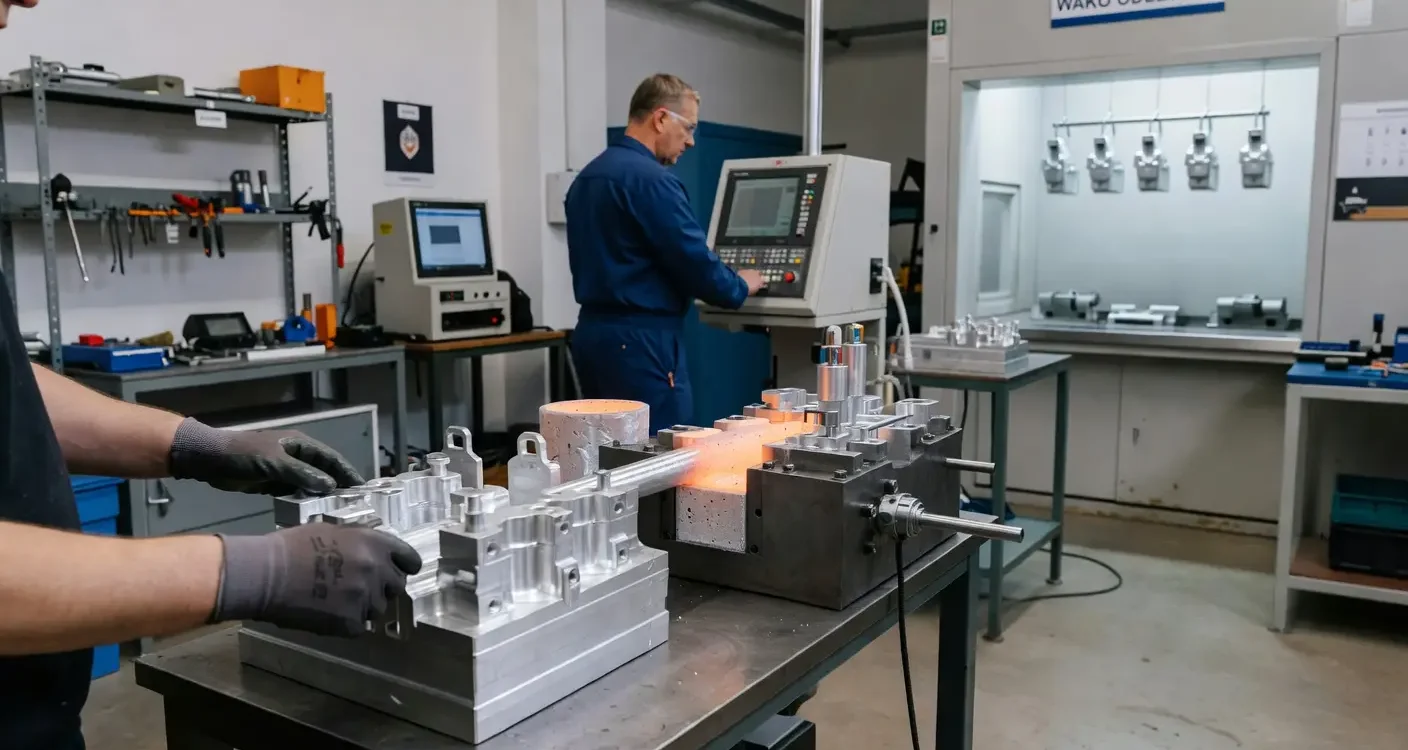
Die casting determines the geometry and tolerances of the aluminum casting even before the mold is made. A precise model takes into account material shrinkage and additional machining, which directly translates into the final dimensions of the component. The machine industry today requires finished parts almost immediately ready for assembly. Combining knowledge of the behavior of light metal alloys with modern finishing techniques allows for the avoidance of costly production adjustments.
How does foundry modeling set the geometry and tolerances?
The casting model forms the basis of the dimensioning and structure of the finished component. In our practice at Wako Odlewnia We compensate for the contraction of alloys at a level of 1–1.5 percent already at the virtual design stage. The designer calculates the final dimensions so that, after the metal has completely solidified, a precise detail is obtained.
Dimensional tolerances of cast-in-place corrugations they fall within the strict range CT5–CT7 according to the international standard ISO 8062. This means deviations of only ±0.3–0.5 mm for every 100 mm of finished product length. Properly prepared initial geometry facilitates subsequent, hassle-free assembly of machine parts.
What should be done before starting the melting process?
Before heating the furnace, it is necessary to precisely determine the chemical composition of the alloy, the target temperature of the mold, and the channel grid of the injection channels. Controlled heat in the crucible prevents premature metal solidification and the formation of so-called cold joints.
The design of the flood system is of great importance for the internal cohesion of the material. The heated metal must fill the cavity evenly, without causing turbulence and closing the air bubbles. The addition of appropriate venting channels allows the gases to freely leave the mold. Proper balance of these parameters protects the entire cast from the formation of internal porosity.
How does the flooding and cooling process work?
We perform the mold filling process gravitationally, adapting the technique to the specifics of the specific order. The solidification process, controlled by special channels inside the mold, directly determines the final microstructure and strength of the part. The too abrupt drop in temperature causes undesirable brittleness of the alloy.
Most dimensional deviations occur precisely during the solidification phase. Uneven contraction at locations with varying wall thickness generates deformation stresses of the detail by 0.2–0.4 mm. Precise control of the cooling time minimizes this type of phenomenon, eliminating the need to re-melt the material.
How do we combine design with a finished product?
We complete the component production cycle in one production chain within our plant in Pruszków. This means a smooth transition from model development to technology casting aluminum, Up to the final surface finishes.
Integration of all stages allows us to continuously verify the quality of the raw material after each cycle. Detecting the slightest structural defect results in immediate adjustment of the parameters on the production line. If you plan to implement new machine components, it is worth considering commissioning the entire cycle by a reliable engineering team.
When is cutting machining necessary?
Mechanical removal of technological overmoulds guarantees accuracy of ±0.05 mm in places requiring the most precise fit. The raw cast after being removed from the mold rarely has sufficiently smooth surfaces for mounting in complex mechanical systems.
We introduce CNC finishing machining and powder coating in several situations:
- The necessity of precise threading of holes and rigorous milling of bearing grooves.
- Detail work in an aggressive environment, which require multi-year anti-corrosion protection.
- High aesthetic requirements of the installation applied to the external elements of enclosures and panels.
Actually, the applied powder coating permanently protects the given alloy, while at the same time not compromising the critical external dimensions.
How does experience allow for the technology to be adapted?
Four decades of our company’s presence in the metallurgical industry make it easier to diagnose the specific requirements of individual sectors of heavy industry. We select the blends and heating procedures to rigorously meet the strength standards for corporate customers.
For the automotive industry we use rates that are characterized by a significantly higher resistance to material fatigue. The energy sector, in turn, requires excellent thermal conductivity and complete casting tightness. Awareness of these technological nuances allows for the rapid start-up of safe serial production.
What most strongly determines the repeatability of castings?
Accurately calculated contraction compensation and rigorous control of heat flow ensure the ideal repeatability of each batch. The combination of precise engineering decisions and strict control of furnace parameters guarantees identical mechanical parameters for every component in the series.
Focusing processes within one machine park radically reduces the risk of communication errors and logistical delays. The absence of intermediaries shortens the waiting time for finished batches of components, guaranteeing full stability of the assembly lines.
The quality of aluminum castings results from precise compensation of metal shrinkage at levels of 1–1.5% already in the model phase. Crucial for the durability of the part are the control of mold temperature and cooling time, which prevents stresses and structural defects. The complete production cycle, including CNC machining and painting, guarantees dimensional accuracy of ±0.05 mm. The adaptation of the technology to the specifics of the automotive or energy industries ensures the desired strength parameters.
FAQ
What is the importance of the alloy selection for the durability of the casting?
The choice of a specific alloy determines the material's fatigue resistance, thermal conductivity, and corrosion resistance. The appropriate proportions of silicon and magnesium influence the metal's ductility, which translates into fewer defects in complex geometries.
Why do the dimensional tolerances of castings require additional machining by cutting?
Standard ISO 8062 foundry tolerances are usually insufficient for bearing bushings or precision threads. Mechanical CNC machining allows for accuracy of the order of one-hundredth of a millimeter, necessary for the proper mating of the moving parts of machines.
How can porosity in internal parts of aluminum castings be avoided?
The elimination of porosity occurs through optimizing the injection system and the use of vent channels in the form of ducts. The stable, laminar flow of metal prevents the closure of air bubbles, which is critical for achieving full sealing of the detail.
How does heat treatment affect the finished cast?
Annealing or tempering processes after casting stabilize the crystalline structure and eliminate internal stresses that arise during solidification. As a result, the finished components gain higher hardness and are less prone to cracking under mechanical load.

 Polski
  English (UK)
  Deutsch
  Español
  Français
  Українська
  Русский
  Čeština
  Slovenčina
  Svenska
  Română