
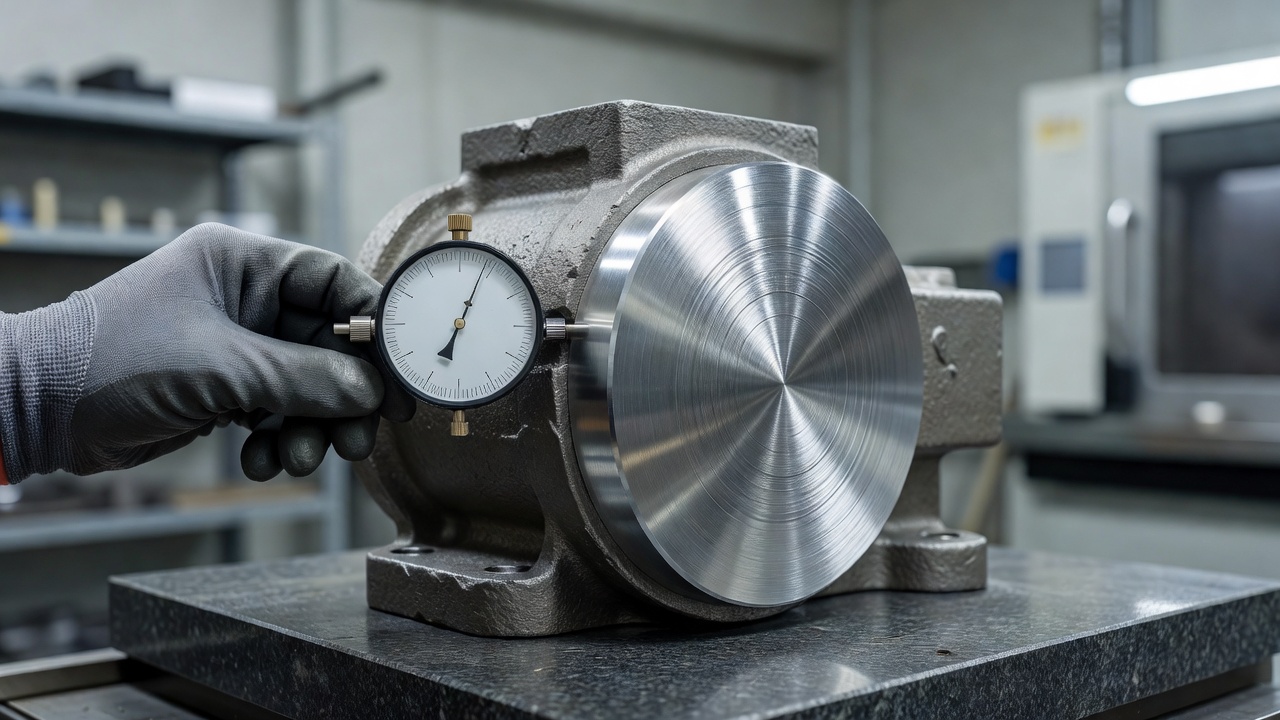
Solid castings directly from the mold are rarely suitable for assembly in machines or vehicles. Before the component reaches the final production line, it undergoes a rigorous assessment of many parameters. Surface quality, precise dimensions, and the internal structure of the material are verified. This finishing process ultimately determines whether the component meets the rigorous strength and functional requirements. Conscious planning of the subsequent steps prevents failures in the finished devices.
What characteristics of raw casting are evaluated before processing?
Before the start of machining, porosity, external structure, and repeatability of geometry are primarily checked. Evaluation of these parameters determines the success of further workshop operations.
In our production practice, we reject works that exhibit excessive gas porosity. Hidden air bubbles prevent the subsequent sealing of the item. The surface taken directly from the mold usually contains natural oxides and residues of the molding sand. Material impurities drastically reduce the adhesion of applied anti-corrosion paints. The hard layer of dirt additionally accelerates the destruction of cutting plates in CNC machines. Deviations resulting from the natural hardening and shrinking of the liquid metal are also verified. Too deep deposits make it impossible to achieve the planned finish without creating a level surface.
How does cutting machining improve the dimensions of the details?
Milling and turning corrects surface curves, drills mounting holes, and generates smooth threads. The cutting tools precisely remove planned excess material, eliminating inaccuracies from the forming stage. The finished component fits seamlessly with adjacent mechanical parts.
Industrial aluminum castings The products that reach the automotive or energy industries are produced in stable production centers. Precision milling machines provide target dimensional tolerances compliant with ISO 8062 standards, most commonly in CT5–CT9 classes. The machines also reduce the original roughness of the material to a level of Ra 1.6–3.2 μm.
The key benefits of performing mechanical machining are:
- achieving perfect tightness on the connections of the engine blocks,
- eliminating harmful gaps in rotating mechanisms,
- preparing a precise base for applying the gaskets.
When does powder coating protect a part?
The powder coating process effectively cuts off bare metal from destructive moisture, UV radiation, and chemicals. Applying paint using an electrostatic field allows for permanent coverage of the complex and deep recesses of the component. External anti-corrosion barriers remain absolutely essential in outdoor equipment.
Burning the powdered material at high temperatures crosslinks the protective polymer layer. A very impact-resistant coating is formed, resistant to scratches and aggressive acidic environments.
Aesthetics play a huge role in consumer appliances or visible elements of construction machinery. The precise selection of colors from the extensive RAL palette enhances the appearance of the finished product. Contrasting colors streamline logistics and facilitate the identification of specific components during assembly of large production lines.
How does modeling affect the quality of parts?
Virtual preparation of the casting model facilitates early planning of machining increments and optimization of mass distribution. The simulation software accurately displays the flow of liquid metal, the locations of the shrinkage-free mold forming zones, and the optimal wall thicknesses.
The engineers at our plant in Pruszków always verify the virtual behavior of the material during solidification. Digital prototyping drastically reduces the risk of having to make costly adjustments during mass production.
The combination of designers, technologists, and machine operators in one location fully protects the consistency of requirements. Changes approved on the computer screen are instantly sent to the cutting department.
The table illustrates the key differences between the raw casting and the part subjected to final machining:
| Measurement category | Straight from the form | After machining and painting |
|---|---|---|
| Surface roughness | Usually above 6.3 μm | Precise 1.6–3.2 μm |
| Dimensional conformity | Risk of contractile abnormalities | Strict ISO 8062 standard |
| Chemical protection | Only natural oxidation | Closed polymer barrier |
How do you know a detail is ready for implementation?
The component is qualified for installation when the verified physical dimensions match the drawing specifications. The support structure must exhibit adequate rigidity, and the applied paint coating must be free of the smallest spatter.
Neglecting finishing stages leads directly to dangerous stresses in assembled engineering structures. Uneven surfaces destroy pressure seals, causing rapid failures of pressure circuits. Advanced production series are verified point-by-point on CMM coordinate measuring machines, providing absolute certainty regarding the element’s performance under difficult operating conditions.
Ensuring the reliability of new systems begins with selecting the contractor; therefore, when subcontracting the production of lightweight metal components, it is worth choosing a foundry that performs the complete finishing process in one department.
Rough casting usually requires assessment of porosity, geometry, and surface quality before it is processed further. Milling machining aligns dimensions, surfaces, and holes, while tolerance and roughness checks determine fit and durability. Die casting reduces the risk of errors, and powder coating provides protection and the required appearance.
FAQ
What characteristics of aluminum casting should be checked before machining?
First, the porosity, surface condition, and the geometry’s conformity with the design are assessed. Trace of shrinkage, contamination, and the stability of the material structure are also important, as they affect the possibility of further milling and turning.
Why is manual machining not enough to make the casting ready for assembly?
Cutting machining provides precise dimensions, but does not solve all technical requirements. Quality control, surface preparation, and coating protection are often still required to ensure that the part is durable in use.
What is the importance of surface roughness in technical parts?
Roughness affects the tightness, friction, and durability of the components that work together. Too high can make assembly difficult, worsen seal performance, and accelerate wear in machines, vehicles, and equipment.
When is powder coating needed in aluminum castings?
Powder coating is needed when the part has to operate in moisture, outdoors, or in a chemically aggressive environment. Additionally, it is used where color, part identification, or the consistent appearance of the entire series are important.
How do you know that the cast is ready for implementation in production?
The readiness is confirmed by consistent dimensions, appropriate surface quality, the absence of defects affecting strength, and a proper protective coating. If a component passes a drawing and measurement inspection, it can be safely sent for assembly.

 Polski
  English (UK)
  Deutsch
  Español
  Français
  Українська
  Русский
  Čeština
  Slovenčina
  Svenska
  Română