
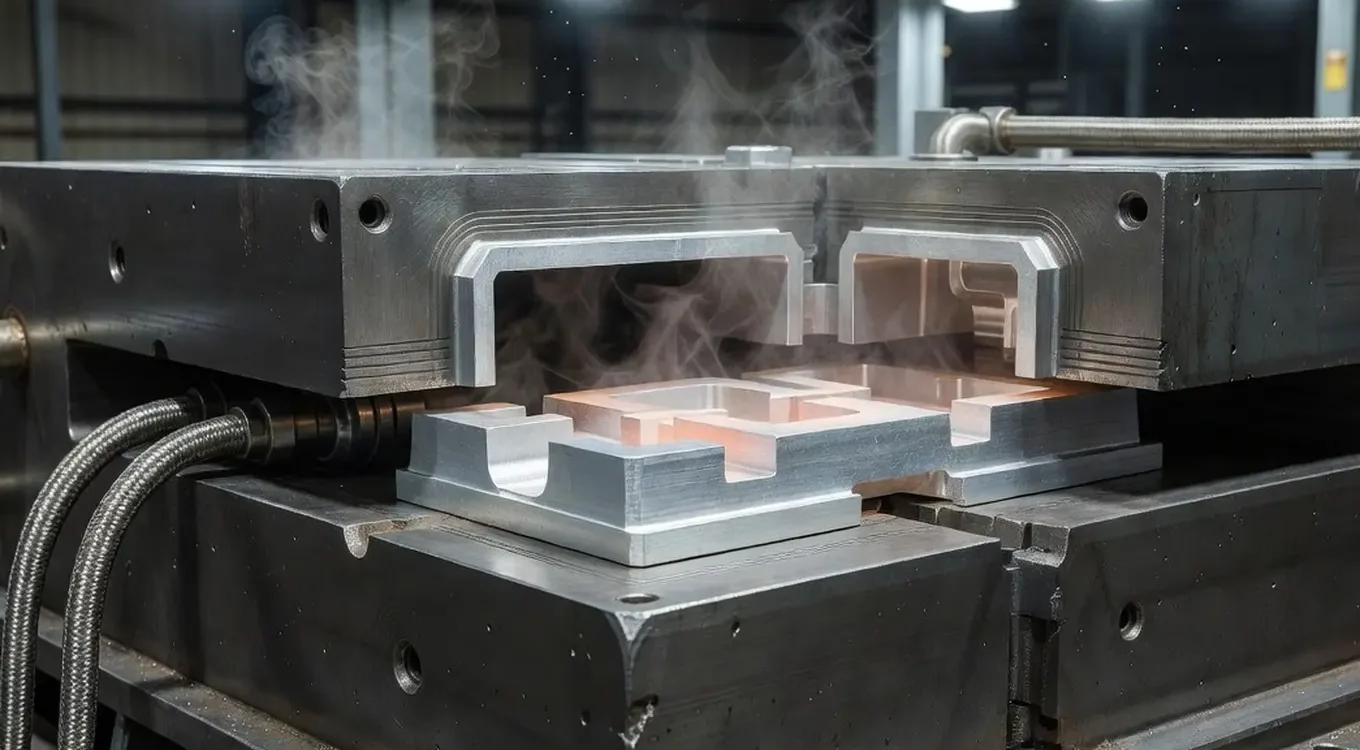
The casting of aluminum alloy molds requires precise cooling and venting of the mold. Only balancing these two parameters can permanently reduce porosity and ensure repeatable quality of the components. Rapid heat dissipation through the metal mold leads to a fine-grained structure that significantly improves mechanical properties and reduces the risk of internal defects in the finished industrial part.
How does cooling the coconut affect its porosity?
Properly planned die casting imposes rapid thermal exchange, This directly translates into the rate of solidification of the alloy. Faster heat dissipation results in smaller grains, which in turn increases the strength and corrosion resistance of the component. In our foundry practice at Wako Foundry, we regularly observe that too slow cooling favors grain growth and undesirable segregation of components. The aluminum alloy shrinks in volume by approximately 4–6.5% during the transition from a liquid state to a solid one. Strict control of this phase effectively minimizes the formation of voids within the metal structure.
Why does free cooling weaken the material?
Free temperature dissipation drastically extends the solidification time in thick sections of castings. In such places, most often at the junctions of T- or L-shaped walls, extensive thermal nodes are formed. The liquid metal does not have time to replenish the volume loss there., resulting in a pore contraction or interendothelial porosity. For example, in details with a thickness exceeding 15 mm, the temperature difference between the outer wall and the core easily exceeds 100°C. This results in an immediate reduction in density and mechanical strength. In elements subjected to dynamic loads, the presence of pores with a diameter exceeding 0.5 mm often disqualifies the entire batch produced.
Where to place cooling channels in a form?
The cooling channels are strategically placed to force directional solidification from the thinnest sections towards the feeding ducts. The standard channel diameters range from 6 to 20 mm, while their optimal distance from the forming surface oscillates within the limits of 7–40 mm. The specific parameters depend directly on the dimensions of the part to be cast. This arrangement stabilizes the temperature distribution and significantly shortens the overall production cycle time. Particularly massive areas are additionally protected by forced circulating cooling with water or compressed air.
What eliminates the bladder and the contracting chambers?
Air vents in the form of very narrow grooves on the surface of the matrix divider (usually with a depth of only 0.2-0.5 mm) allow the escape of gases pushed out by the stream of the alloy. The power system with overfills compensates for the natural volume contraction, Acting as a safe reservoir of liquid aluminum during the final solidification phase. Meanwhile, the injection system performs a completely different task—its cross-sections and distribution channels ensure a smooth, turbulence-free filling of the cavity of the coke oven. The strict separation of the feeding and metal delivery roles eliminates turbulence. For large-sized parts weighing more than 2 kg, the use of precisely calculated injection reduces gas defects by up to 60%.
How is the venting system of the mold adjusted?
After casting a trial batch of details, technologists carefully analyze the location of defects within the structure of the material. Most often, the air-conditioning system itself is corrected. by adding new cuts, mechanically deepening existing slot grooves, or cleverly changing the position of the transfer systems. Such tool interventions quickly stabilize the solidification process without requiring costly redesign of the entire steel mold. Pointed correction allows the original tooling to be retained and smoothly transition into the main phase of the serial production of the order.
When is a change in the geometry of the form necessary?
Modifying the internal geometry becomes the only option when the extremely thin walls (below 3-4 mm) or structural ribs are present. refuse to properly fill the tank despite perfect cooling. The main culprit is often too sharp transition surfaces or restrictive angles of slopes. Technologists then correct the radii of the curves, thicken critical sections, or change the working angle of the entire detail in shape. Decisions regarding such intrusive changes are always based on digital analysis of results from advanced flow simulation programs. This eliminates the formation of defects such as cold flows and stress cracks.
What should be remembered about process control?
Sustainable management of the thermal cycle and the removal of gases absolutely guarantees a homogeneous alloy structure and full pressure tightness.
- Controlled cooling limits destructive ventricular contractions.
- Systematic ventilation eliminates gas bubbles.
- Separating the inlet system from the overflow tanks stabilizes the flow.
As an experienced contractor for the automotive and defense industries, at Wako Foundry we treat these principles as the foundation of repeatability. If you plan to implement components with high mechanical requirements, it is a good idea to consult with the technology regarding the shape of the blank before the milling stage of the production mold.
The cooling and venting control in the casting process determines the fine-grained structure, lower porosity, and stable dimensions. Too slow heat dissipation favors shrinkage pits, and properly designed cooling channels, overflow channels, and vents minimize gas defects. In mass production, correcting the venting system helps stabilize the process without having to redesign the entire mold.
FAQ
Why does cooling during die casting have such a strong effect on porosity?
Rapid cooling forces a shorter solidification time and a finer grain structure, which limits the formation of internal voids. When heat is removed too slowly, shrinkage pits and intergranular porosity are more likely to form in the casting.
What role do cooling channels in the cockpit play?
The cooling channels direct the heat pickup so that solidification occurs in a direction from the thinner to the thicker casting zones. This makes it easier to maintain stable dimensions and to reduce defects in areas with a high mass of material.
Why are air vents, overflow pipes and power outlets used?
The venting channels remove the gases from the mold cavity, and the overfills compensate for the volume contraction of the metal in the final phase of solidification. This solution reduces the risk of blisters, cavities, and local material defects.
When should the geometry of the cockpit be changed instead of just correcting the air pressure?
Geometric modification is necessary when thin sections or ribs do not fill properly despite proper cooling and venting. In practice, this usually applies to too sharp transitions, unfavorable angles of inclination, or too small radii of curvature.
What effect does simultaneous cooling and ventilation control have on serial production?
Simultaneous control of both parameters provides more repeatable casting quality, fewer defects, and better pressure tightness of the details. The process also becomes more stable in terms of cycle time and mechanical strength of the finished components.

 Polski
 English (UK)
 Deutsch
 Español
 Français
 Українська
 Русский
 Čeština
 Slovenčina
 Svenska
 Română