
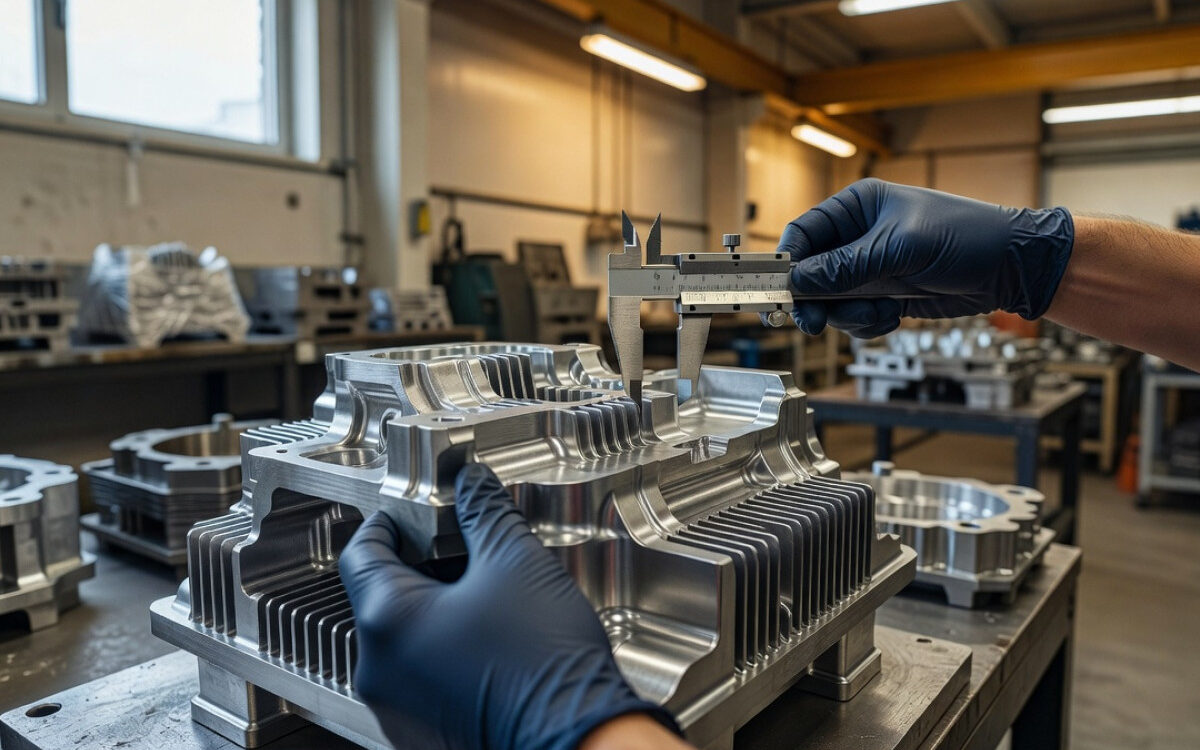
In the production of advanced components for medicine, energy, and defense, even low material weight is not enough. The technical usefulness is determined by the precise set of mechanical, corrosion, and thermal properties. The appropriate chemical composition and the applied molding technology determine the durability and safety of the finished components in extremely harsh operating conditions.
Why is lightness alone not enough in the selection of alloys?
The lightness of the base material, whose density oscillates around 2.7 g/cm³, is only a starting point for the designers. In our foundry practice, we observe that technical parts operating under continuous load require a specific crystalline structure. Aluminum components must combine low weight with stress resistance of the order of tens to several hundred megapascals., Otherwise, they will undergo rapid deformation. The use of mass reduction alone in the defense and machine industries leads to fatigue cracks and premature failure of the entire mechanical system.
How does the alloy composition affect the casting parameters?
The addition of silicon at levels of 7 to 12 percent significantly improves the fluidity of the liquid metal, facilitating the filling of complex molds and reducing casting shrinkage to approximately 1-2 percent. Enriching the mixture with magnesium, in turn, increases the base strength, but the final strength remains unchanged. Corrosion resistance depends strictly on the obtained microstructure and the parameters of the heat treatment. Al-Si-Mg industrial alloys such as the popular EN AC-42100 are very well suited for machining. Proper balance of these elements allows for achieving the desired operational parameters without weakening the structure.
Which properties determine the performance under load?
High fatigue strength and dimensional stability under cyclic stresses form the foundation for intensively operated machines. The admixture of copper or zinc can raise the yield point of the material, but Actual fatigue resistance results from appropriate thermal improvement and real working conditions. Designed accordingly aluminum castings The artificially aged materials achieve a hardness that allows for thousands of hours of safe operation in heavy industry. Their resistance to milling or turning allows for precise connections that reduce vibrations.
Why in medicine does dimensional stability matter?
Aluminum components in the medical industry primarily serve as the foundation for the housings of specialized diagnostic devices and external supports where direct contact with tissues does not occur. By supplying these types of components, we emphasize The resistance of the coatings to repeated cleaning and sterilization in autoclaves at a temperature of 134°C. The rigidity of the structure and the smoothness of the surface after finishing minimize the risk of microbial growth. Maintaining strict tolerances of the order of one hundredth of a millimeter facilitates the assembly of delicate electronic equipment.
What changes do the requirements of the energy sector bring?
Maintaining structural consistency becomes an operational priority in the face of extreme temperature fluctuations, often exceeding 150°C. Aluminum components they must withstand continuous vibrations and an aggressive corrosive environment when working outdoors. The use of alloys with enhanced thermal stability is particularly effective in wind turbine gearbox housings or radar system casings. If you plan to implement components that operate in such harsh conditions, it is worth consulting on the optimization of the casting design at an early conceptual stage.
How does computer modeling reduce porosity?
Digital flow simulations allow engineers to analyze the behavior of liquid metal in detail with an accuracy of up to single degrees Celsius. Early prediction of freezing zones reduces the risk of the formation of microcracks and significantly improves the density of cast elements. Optimizing the geometry of the injection system can reduce the rate of production defects and facilitate maintaining a constant wall thickness. Precise reproduction of the dimensions eliminates the need for time-consuming adjustments on numerically controlled machines.
What ensures the repeatability of a production series?
Maintaining the identical properties of successive batches of material requires strict control of the melting and solidification parameters. At Wako Odlewnia, we draw on more than forty years of experience, monitoring every stage of the process—from foundry modeling to powder coating. Full monitoring of the manufacturing and finishing process allows to stabilize the strength parameters. The finished parts are delivered to customers from the machinery or defense industry with a high repeatability of the series, meeting the requirements of the most stringent technical standards.
The use of aluminum casting is determined not only by its low weight, but also by a set of mechanical, corrosion, and thermal properties. The alloy composition influences the ductility, shrinkage, machinability, and operational durability, while foundry modeling limits porosity and dimensional variation. In medicine, dimensional stability and surface quality are crucial; in energy and defense—durability, operating temperature, and safety.
FAQ
What properties of the alloy are most important for aluminum castings in technical applications?
The most important qualities are strength, resistance to corrosion, dimensional stability, and thermal properties. The material’s own lightness is not enough if the component is to operate under load, vibrations, or at elevated temperatures. The usefulness is also determined by the microstructure obtained after casting and heat treatment.
Why does the chemical composition of an alloy have such a big impact on aluminum casting?
The chemical composition determines ductility, casting shrinkage, machinability, and corrosion resistance. For example, a suitable silicon content improves mold filling, and magnesium can increase the material strength. However, the final parameters also depend on the manufacturing and heat treatment technologies.
What is crucial in aluminum castings operating under load and vibrations?
The key factors are fatigue strength, adequate stiffness, and dimensional stability. The element must maintain its parameters under cyclic stresses; otherwise, deformation or cracking is likely. It is also essential to have the ability to perform precise finishing machining that improves assembly and system operation.
Why in the medical industry must aluminum casting have good surface quality?
The smooth surface makes it easier to maintain hygiene and reduces the risk of contamination. It is also important to have resistance to repeated cleaning and sterilization, as well as to maintain tight dimensional tolerances. This ensures that the components work well with delicate equipment.
How does foundry modeling affect the quality of aluminum castings?
Foundry modeling allows for earlier prediction of metal flow, solidification zones, and porosity-prone areas. This enables optimization of the injection system and the detail geometry, and as a result, reduces production bottlenecks. Better process control also increases the repeatability of subsequent batches.

 Polski
  English (UK)
  Deutsch
  Español
  Français
  Українська
  Русский
  Čeština
  Slovenčina
  Svenska
  Română